

Key point
Mezzanine flooring refers to the deck surface of a mezzanine floor: the material laid across the structural steelwork to create the walking surface. The right flooring choice depends on the intended use of the mezzanine.
Storage and warehouse mezzanines typically use P5 moisture-resistant chipboard. Office and commercial mezzanines use chipboard as a structural deck with a finished surface layer of carpet, vinyl or LVT. Retail and public-facing mezzanines use premium finished surfaces.
The deck specification must match the load rating of the mezzanine and the environment in which it operates.
When people search for ‘mezzanine flooring’, they are usually asking one of two things: what material is used as the deck surface of a mezzanine floor, or what finished floor covering should go on top of a mezzanine. This guide covers both.
Western Industrial has been specifying and installing mezzanine flooring as part of complete mezzanine floor installations since 1979. The choice of decking and floor finish affects the structural performance, the appearance, the durability and the cost of the installation.
Mezzanine deck boards: the structural layer
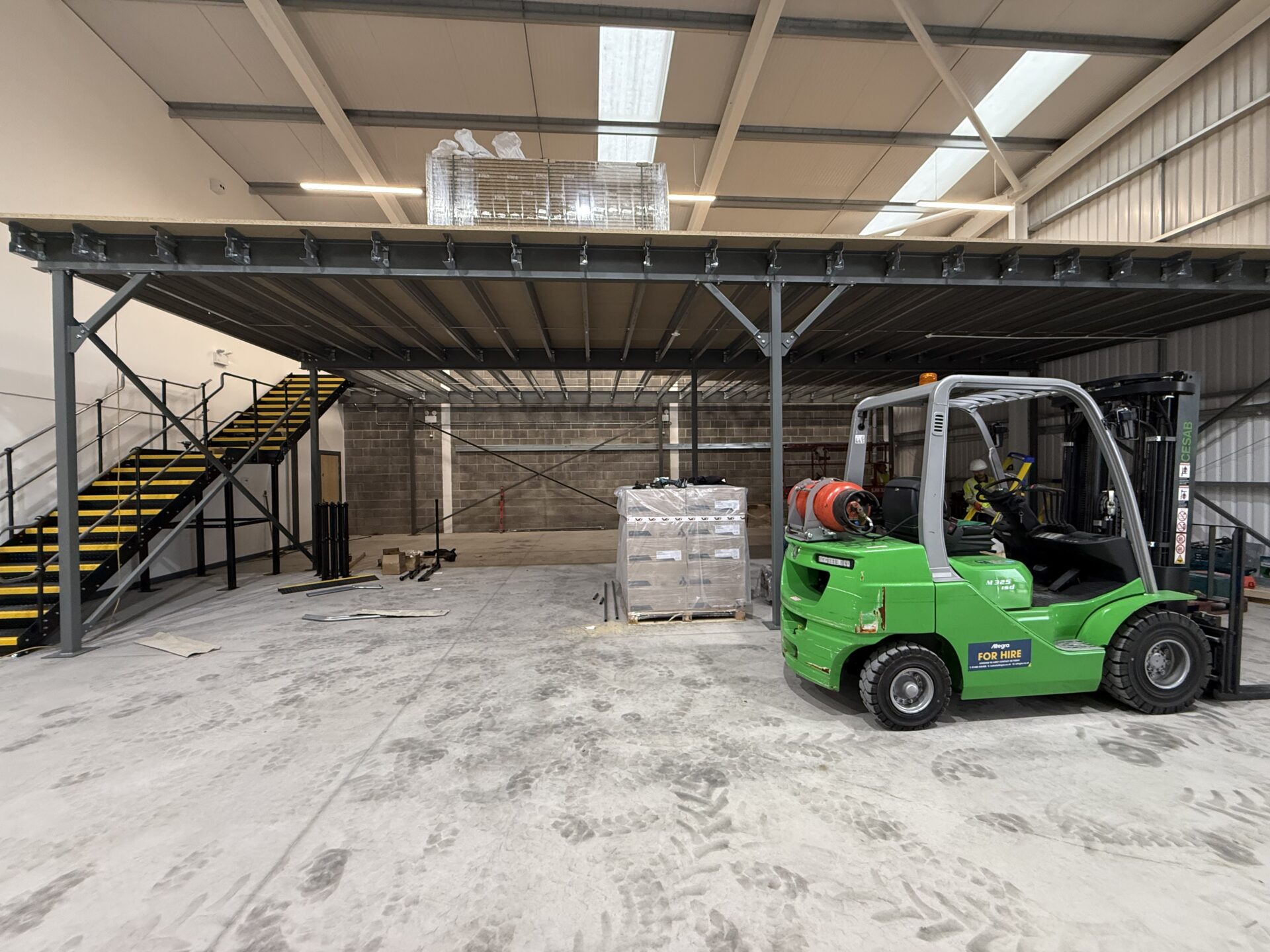
The structural deck of a mezzanine floor is the material laid across the secondary joists to create the load-bearing surface. This is the deck board, and it is a structural component, not just a floor finish. It must be specified to carry the design load of the mezzanine and appropriate for the environment.
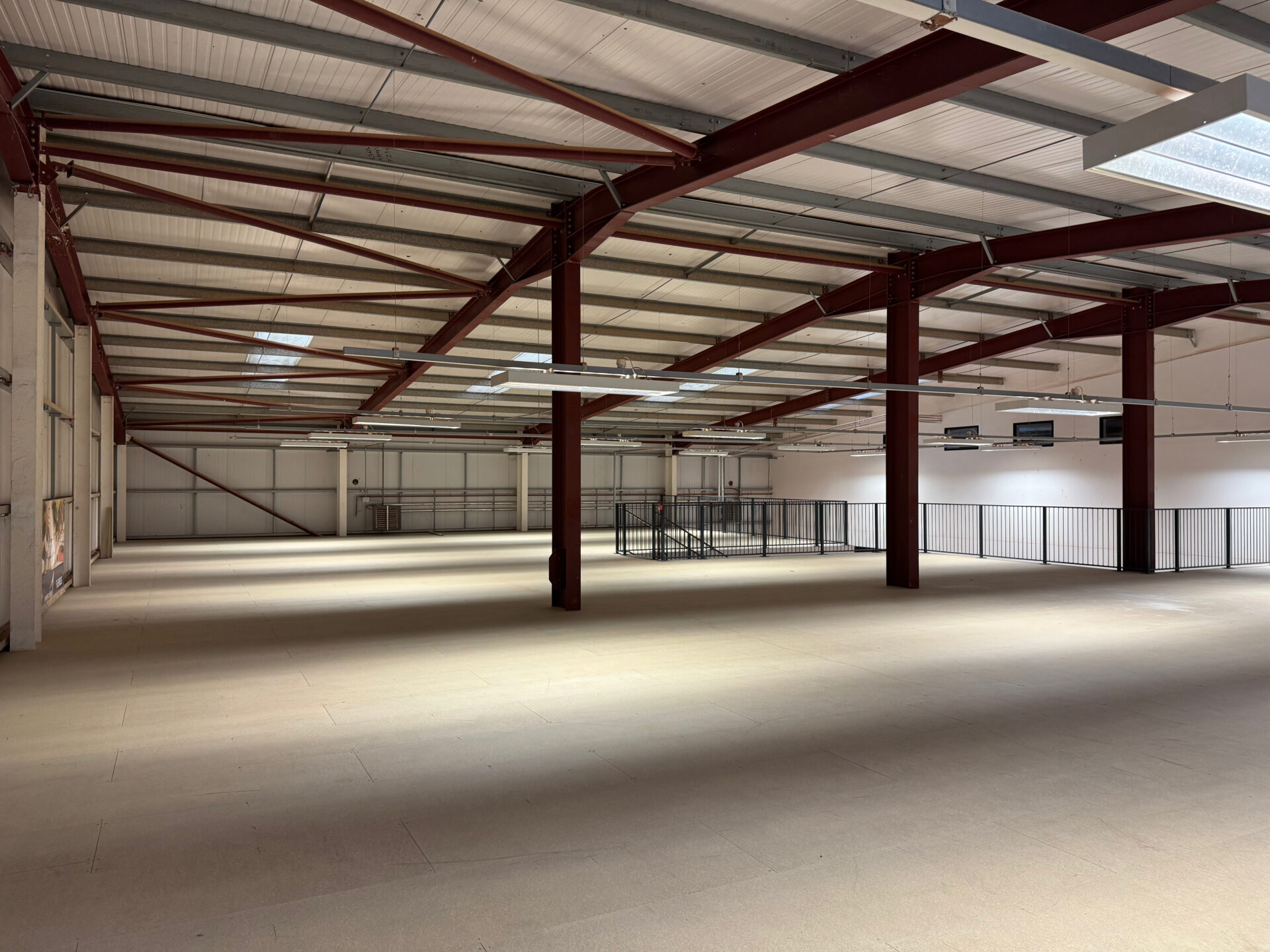
P5 moisture-resistant chipboard (standard specification)
P5 chipboard is the standard deck material for storage, warehouse and light industrial mezzanine floors. P5 designation confirms moisture resistance under EN 312, meaning the board maintains its structural performance in the humid conditions common in warehouse environments.
Standard dimensions: 2,400mm x 600mm x 38mm. This is the size used on most mezzanine floor installations in the UK.
P5 chipboard is appropriate for mezzanine floors designed to carry up to 600 kg/m². For heavier loads, a thicker board (22mm-25mm) or a different material is required.
The boards are laid across secondary joists and fixed with self-tapping screws, with staggered joints to avoid continuous lines of weakness. The bare board surface is appropriate for storage and warehouse environments. For office or commercial use, a finished surface layer is applied on top.
Structural plywood
Structural plywood is specified where higher strength, stiffness or surface hardness is required. It is more dimensionally stable than chipboard under varying humidity conditions and provides a harder wearing surface. Plywood is used on heavier-duty storage mezzanines, on mezzanines in food production or hygienic environments where chipboard is not appropriate, and where a higher-quality base for surface finishes is required.
Steel chequer plate
Steel chequer plate decking is used on industrial and factory mezzanine floors where the environment is too harsh for timber-based boards, where heavy equipment is positioned on the deck, or where the floor will be exposed to oils, chemicals or significant moisture. It is significantly heavier than chipboard and requires a more robust structural specification. Chequer plate also provides the anti-slip surface required in many industrial environments without additional treatment.
Mezzanine flooring in the UK: finishes
For office, commercial and retail mezzanines, a finished floor covering is applied on top of the structural deck board. The choice of finish affects appearance, acoustic performance, durability and cost.
Carpet tile
Carpet tile is the most common office mezzanine floor finish. It is practical, acoustically absorbent and easy to replace in sections if damaged. A good quality commercial carpet tile on a mezzanine office looks and feels the same as a carpet tile on a conventional office floor. It is appropriate for any office, meeting room or welfare area on a mezzanine level.
Vinyl and LVT (luxury vinyl tile)
Vinyl and LVT finishes provide a hard-wearing, easy-clean surface appropriate for commercial environments, welfare areas, kitchens, accessible toilet facilities and any mezzanine area subject to spills or heavy footfall. LVT in wood-effect or stone-effect finishes is commonly used on retail mezzanines and commercial offices where a premium appearance is required without the cost of natural materials.
Hardwood and engineered timber
Hardwood or engineered timber flooring is specified for high-specification commercial, retail and hospitality mezzanines where a premium finish is required. It provides a warm, high-quality appearance and is appropriate for any environment where the mezzanine is visible to customers or forms part of a premium brand environment. It is more expensive than carpet or vinyl and requires a flat, stable structural deck.
Resin and epoxy
Resin and epoxy floor coatings are used in food production, pharmaceutical and hygienic environments where a seamless, easy-clean surface is required. They are applied over a suitable substrate (typically plywood or chequer plate rather than chipboard) and provide excellent chemical resistance and hygiene performance.
No finish (bare deck)
For storage, warehouse and industrial mezzanines, the bare P5 chipboard or steel chequer plate deck is left without a surface finish. This is appropriate and entirely standard for operational environments where appearance is not a priority. The bare board surface is durable enough for the foot traffic and pallet truck movements typical of a warehouse environment.
How to specify the right mezzanine floor decking
The flooring specification for a mezzanine follows directly from the answers to three questions:
What is the mezzanine used for?
Storage and warehouse: P5 chipboard deck, no finish required. Office: P5 chipboard deck with carpet tile or LVT finish. Retail or customer-facing: P5 or plywood deck with LVT, hardwood or high-specification carpet. Industrial or food production: plywood or steel chequer plate with resin coating or left bare.
What is the load capacity?
For mezzanines designed to carry up to 600 kg/m², standard 38mm P5 chipboard is adequate. For loads above 600 kg/m², a thicker board specification or steel deck is required. The deck specification is part of the structural design and is confirmed by the engineer at the design stage.
What is the environment?
Dry warehouse environment: P5 chipboard as standard. Humid or wet environment: plywood or steel. Chemical or food production: steel chequer plate or plywood with resin coating. Office or commercial: P5 chipboard with appropriate surface finish.

Mezzanine flooring costs
The cost of the structural deck is included in the overall mezzanine floor installation cost. As a guide:
- P5 chipboard deck (38mm): included in the standard mezzanine installation cost. Boards are approximately £25 – £40 each for direct purchase.
- Structural plywood deck: adds approximately £10 – £20 per m² compared to chipboard.
- Steel chequer plate deck: adds approximately £30 – £60 per m² compared to chipboard.
- Carpet tile finish: approximately £15 – £40 per m² supply and fit.
- Commercial vinyl / LVT: approximately £20 – £50 per m² supply and fit.
- Hardwood or engineered timber: approximately £40 – £90 per m² supply and fit.
“Western Industrial added a mezzanine floor to our warehouse, allowing us to make much better use of our space. Paul’s team were very reliable, and the mezzanine was constructed very quickly and to a high standard. Highly recommended!”
— Google Review, 5★
“Could not be more impressed by this company or David Moore. Extremely professional throughout. Access to great products and tradesmen that have totally transformed our office space. HIGHLY RECOMMENDED.”
— Google Review, 5★
Frequently asked questions about mezzanine flooring
The structural deck of most mezzanine floors is P5 moisture-resistant chipboard, 2,400mm x 600mm x 38mm. This is laid across the steel joists and fixed in place. For office and commercial mezzanines, a finished surface layer of carpet tile, vinyl, LVT or hardwood is applied on top of the structural deck. For storage and warehouse mezzanines, the bare chipboard deck is left without a surface finish.
P5 chipboard is a load-bearing chipboard classified to EN 312 for use in humid conditions. The P5 designation confirms that the board maintains its structural performance in the moisture levels typical of warehouse and industrial environments. It is the standard deck material for UK mezzanine floor installations because it combines adequate structural performance, moisture resistance and cost-effectiveness.
Yes. For office, commercial and retail mezzanines, the floor finish is specified as part of the overall design. We can supply and install carpet tile, vinyl, LVT, hardwood and resin finishes as part of the mezzanine installation contract. The finish choice is discussed at the design stage and priced within the overall project quotation.
For warehouse mezzanines used for storage or picking operations, the bare P5 chipboard deck is appropriate and does not need a surface finish. The board surface provides adequate grip for foot traffic and hand pallet trucks. If the mezzanine includes a packing or welfare area, a vinyl or carpet tile finish in that area is commonly specified.
The structural chipboard deck is included in the standard mezzanine floor installation cost. Finished surface layers are additional: carpet tile adds approximately £15 – £40 per m², commercial vinyl or LVT adds £20 – £50 per m², and hardwood adds £40 – £90 per m². For a free site survey and accurate quotation for your project, contact us.
A load plate is a permanently fixed label or plaque on the mezzanine structure that states the maximum uniform distributed load the floor is designed to carry. It is a requirement of the mezzanine handover documentation and is typically fixed to a column in a visible location. The load plate allows operators and future occupants to identify the capacity of the floor without needing to locate the original structural calculations. It is also relevant for insurance purposes and for any future structural assessment. Every mezzanine floor supplied by Western Industrial is provided with a load plate as part of the standard handover pack.
Get a Free Quote
We’re always on the look out for new projects, both big and small. Send us your contact details and we’ll be in touch!

About Western Industrial
Established in 1979, Western Industrial Group have grown to a dedicated & professional workforce, delivering consistently high quality services across a range of projects, large & small.
From Mezzanine Floors to Warehouse Storage and Racking, Western Industrial Business Interiors design, supply, manage and install, to provide you with a complete office refurbishment package.
We supply and install Mezzanine Floors, Office Partitioning, Air Conditioning, Ventilation & Suspended Ceilings, through to all your Electrical & Mechanical requirements.